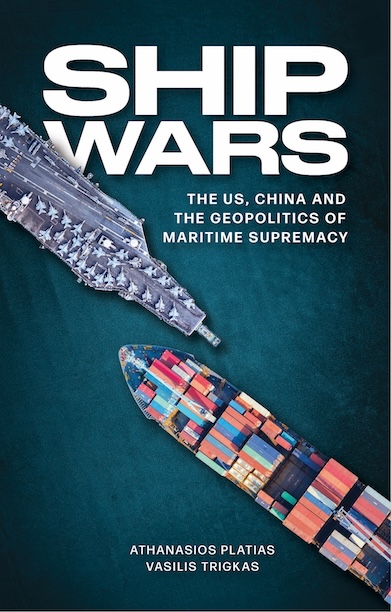
Ship Wars
The US, China and the Geopolitics of Maritime Supremacy
Examines the vital importance of global shipping in our new era of great power competition.
Description
Chips and artificial intelligence will define the geopolitical order of this century. Yet a maritime supply shock—disrupting the minerals that feed semiconductor production—could cripple industries within days. No economy can withstand sustained food or energy scarcity. Merchant fleets and the naval forces that threaten them therefore have the power to bring the world to a grinding halt.
For the first time in a century, the global balance of sea power is shifting. The United States, which has dominated the maritime commons since World War Two, now faces a peer competitor in China. Eurasian states once aligned with the hegemonic maritime power confront a fragmented order of competing spheres. Unlike in the Cold War, when American naval and commercial primacy allowed it to operate with little contest, today’s strategic conflicts are asymmetric and fought through geoeconomic rather than traditional means. As geopolitical realities shift, global rivalries are weaponising interdependence: ports are securitised, chokepoints contested, shipping networks sanctioned and the maritime economy transformed into a logistical chessboard.
From the Houthi attacks on Red Sea shipping to Iran’s closure of the Strait of Hormuz, from the Arctic to the South China Sea, Ship Wars maps the dynamics of a new US–China Cold War.
Author(s)

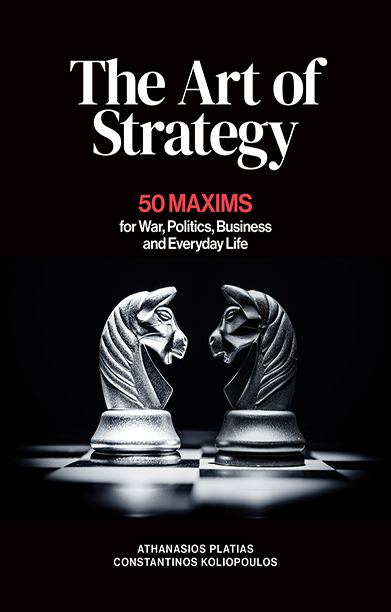
Athanasios Platias is President of the Council of International Relations-Greece, and Professor Emeritus of Strategy at the University of Piraeus. He has been a Ford Foundation fellow at Harvard University, a research fellow at Cornell University and a MacArthur fellow at the Massachusetts Institute of Technology. He is the co-author of Ship Wars; The Art of Strategy; and Thucydides on Strategy (all published by Hurst).
Vasilis Trigkas is Assistant Professor of Global Affairs at Schwarzman College, Tsinghua University, specialising in strategic studies, US–China relations and geoeconomics. He is the co-editor of China: A Herodotian Mission for Politics, Economy, Strategy and Culture (Kerkyra Publications, 2026).
FAQs
Frequently Asked Questions
What is "Ship Wars" about?
Chips and artificial intelligence will define the geopolitical order of this century. Yet a maritime supply shock—disrupting the minerals that feed semiconductor production—could cripple industries within days. No economy can withstand sustained food or energy scarcity. Merchant fleets and the naval forces that threaten them therefore have the power to bring the world to a grinding halt.
For the first time in a century, the global balance of sea power is shifting. The United States, which has dominated the maritime commons since World War Two, now faces a peer competitor in China. Eurasian states once aligned with the hegemonic maritime power confront a fragmented order of competing spheres. Unlike in the Cold War, when American naval and commercial primacy allowed it to operate with little contest, today’s strategic conflicts are asymmetric and fought through geoeconomic rather than traditional means. As geopolitical realities shift, global rivalries are weaponising interdependence: ports are securitised, chokepoints contested, shipping networks sanctioned and the maritime economy transformed into a logistical chessboard.
From the Houthi attacks on Red Sea shipping to Iran’s closure of the Strait of Hormuz, from the Arctic to the South China Sea, Ship Wars maps the dynamics of a new US–China Cold War.
Who wrote "Ship Wars"?
"Ship Wars" was written by Athanasios Platias and Vasilis Trigkas.
Athanasios Platias is President of the Council of International Relations-Greece, and Professor Emeritus of Strategy at the University of Piraeus. He has been a Ford Foundation fellow at Harvard University, a research fellow at Cornell University and a MacArthur fellow at the Massachusetts Institute of Technology. He is the co-author of Ship Wars; The Art of Strategy; and Thucydides on Strategy (all published by Hurst).
Vasilis Trigkas is Assistant Professor of Global Affairs at Schwarzman College, Tsinghua University, specialising in strategic studies, US–China relations and geoeconomics. He is the co-editor of China: A Herodotian Mission for Politics, Economy, Strategy and Culture (Kerkyra Publications, 2026).
Related books