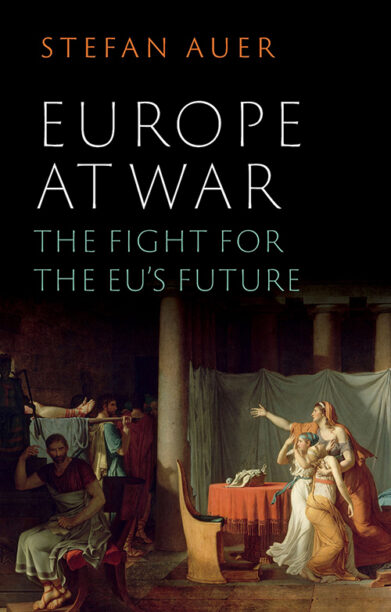
Europe at War
The Fight for the EU's Future
As Europe prepares for war to defend peace, the conflict in Ukraine is reshaping the future—and testing the foundations—of the European project.
Description
Europe’s future is being decided on its eastern frontier. Russia’s full-scale invasion of Ukraine poses a fundamental challenge to the European project. To protect peace, many Europeans now believe that they must prepare for war. A Europe that long prided itself on being a peace project is being forced to think and act like a war project. Yet the European Union is not, and is unlikely to become, a military alliance. The struggle over its eastern border is therefore also a struggle over what kind of Europe can—and should—emerge.
Stefan Auer asks what the war in Ukraine will mean for the continent, tracing how security is reshaping the EU’s institutions, politics and understanding of itself. Just as the Cold War helped define European integration before 1989, the war in Ukraine is likely to shape contemporary relations for decades to come. An external enemy—Vladimir Putin’s Russia—could spur Europe’s nations towards an ‘ever closer union’. But after many years of overlapping crises, the war could just as easily reinforce fragmentation. And the greater the security threat, the greater the temptation for the EU to compromise the principles—democracy and the rule of law—it claims to defend.
Author(s)

Stefan Auer is Professor at the University of Hong Kong. Twice named Jean Monnet Chair in EU Studies, his books include Europe at War and European Disunion (both published by Hurst); and the award-winning Liberal Nationalism in Central Europe (Routledge), winner of the ‘Best Book in European Studies’ from the University Association for Contemporary European Studies. He has contributed to International Affairs, the Journal of Common Market Studies and West European Politics, among others.
FAQs
Frequently Asked Questions
What is "Europe at War" about?
Europe’s future is being decided on its eastern frontier. Russia’s full-scale invasion of Ukraine poses a fundamental challenge to the European project. To protect peace, many Europeans now believe that they must prepare for war. A Europe that long prided itself on being a peace project is being forced to think and act like a war project. Yet the European Union is not, and is unlikely to become, a military alliance. The struggle over its eastern border is therefore also a struggle over what kind of Europe can—and should—emerge.
Stefan Auer asks what the war in Ukraine will mean for the continent, tracing how security is reshaping the EU’s institutions, politics and understanding of itself. Just as the Cold War helped define European integration before 1989, the war in Ukraine is likely to shape contemporary relations for decades to come. An external enemy—Vladimir Putin’s Russia—could spur Europe’s nations towards an ‘ever closer union’. But after many years of overlapping crises, the war could just as easily reinforce fragmentation. And the greater the security threat, the greater the temptation for the EU to compromise the principles—democracy and the rule of law—it claims to defend.
Who wrote "Europe at War"?
"Europe at War" was written by Stefan Auer.
Stefan Auer is Professor at the University of Hong Kong. Twice named Jean Monnet Chair in EU Studies, his books include Europe at War and European Disunion (both published by Hurst); and the award-winning Liberal Nationalism in Central Europe (Routledge), winner of the ‘Best Book in European Studies’ from the University Association for Contemporary European Studies. He has contributed to International Affairs, the Journal of Common Market Studies and West European Politics, among others.
Related books