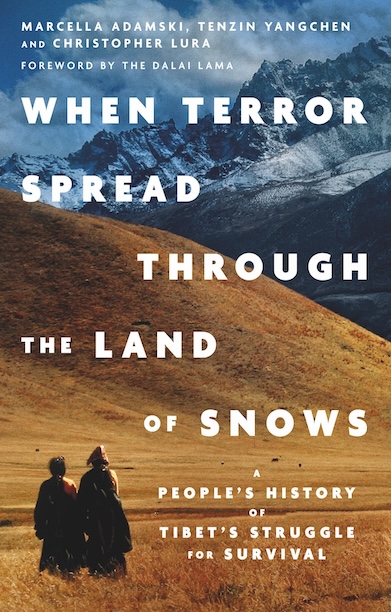
When Terror Spread Through the Land of Snows
A People's History of Tibet's Struggle for Survival
Foreword by The Dalai Lama
A poignant oral history of China’s violent invasion and conquest of Tibet—told, for the first time, by Tibetans themselves.
Description
Communist China’s violent conquest of Tibet has been narrated by outsiders. Here, Tibetans relate their own experiences—page-turning, eyewitness testimonies of a terrifying and extraordinary struggle for survival.
From 2007 to 2017, the authors recorded over 300 interviews with Tibetan refugees scattered across the world. In this book, they weave together eighteen of those stories. The result is a vivid and deeply personal history of China’s systematic assault on Tibetan culture, traditions and ways of life as Mao Zedong’s armies swept through the isolated plateau. From the 1949 Chinese Revolution to the present, they offer a moving ground-level account of the brutal invasion and subjugation of Tibet—forced sterilisations, executions and torture, mass displacement, and the destruction of thousands of Buddhist monasteries. But this is also a tale of resistance and resilience: of the monks, nomads and traders who took up arms to defend themselves; of the refugees who found solace in their faith to cope with the loss of their homeland; and of the diaspora Tibetans campaigning for justice today.
With China still occupying Tibet, and sharply escalating repression at home and abroad, this is the devastating and inspiring story of the Tibetan people’s ongoing fight to be free.
Table of contents
Prologue
List of Illustrations
Part I : THE INVASION BEGINS: AMDO AND KHAM , 1949 – 1958
Part II: CRISIS IN LHASA AND THE FALL OF TIBET, 1951 – 1959
Part III: THE MONKS FLEE THE MONASTERIES, 1959
Part IV: THE RISE AND FALL OF THE CHUSHI GANGDRUG , 1958 – 1970s
Part V: IN THE AFTERMATH OF CONQUEST, 1959 – Present Day
Selected Bibliography
Conclusion
Index
Author(s)

Marcella Adamski is the founder and Executive Director of the Tibet Oral History Project. She has worked as a clinical psychologist with international humanitarian and human rights organisations including Survivors International and the Tibet Justice Center. Her interviews with Tibetan women and child refugees about conditions in Chinese-occupied Tibet inspired His Holiness the Dalai Lama to urge that the elders of Tibet be interviewed next to ensure that their stories be recorded for generations to come. In response, Adamski founded the Tibet Oral History Project in 2003.

Tenzin Yangchen is a Tibetan translator and interpreter born in India and who lives in the Tibetan refugee community of Bylakuppe, India. She speaks Tibetan, English, Hindi and Kannada, and is Outreach Director for the Tibet Oral History Project. She has also worked in her local Tibetan co-operative office and currently serves as Managing Trustee of the Gesar Foundation.

Christopher Lura is an editor and writer whose contributions helped make Digital Empires: The Global Battle to Regulate Technology (Oxford University Press, 2023) a Financial Times Best Book of 2023 and The Brussels Effect: How the European Union Rules the World (Oxford University Press, 2020) a Foreign Affairs Best Book of 2020.
FAQs
Frequently Asked Questions
What is "When Terror Spread Through the Land of Snows" about?
Communist China’s violent conquest of Tibet has been narrated by outsiders. Here, Tibetans relate their own experiences—page-turning, eyewitness testimonies of a terrifying and extraordinary struggle for survival.
From 2007 to 2017, the authors recorded over 300 interviews with Tibetan refugees scattered across the world. In this book, they weave together eighteen of those stories. The result is a vivid and deeply personal history of China’s systematic assault on Tibetan culture, traditions and ways of life as Mao Zedong’s armies swept through the isolated plateau. From the 1949 Chinese Revolution to the present, they offer a moving ground-level account of the brutal invasion and subjugation of Tibet—forced sterilisations, executions and torture, mass displacement, and the destruction of thousands of Buddhist monasteries. But this is also a tale of resistance and resilience: of the monks, nomads and traders who took up arms to defend themselves; of the refugees who found solace in their faith to cope with the loss of their homeland; and of the diaspora Tibetans campaigning for justice today.
With China still occupying Tibet, and sharply escalating repression at home and abroad, this is the devastating and inspiring story of the Tibetan people’s ongoing fight to be free.
Who wrote "When Terror Spread Through the Land of Snows"?
"When Terror Spread Through the Land of Snows" was written by Marcella Adamski, Tenzin Yangchen and Christopher Lura.
Marcella Adamski is the founder and Executive Director of the Tibet Oral History Project. She has worked as a clinical psychologist with international humanitarian and human rights organisations including Survivors International and the Tibet Justice Center. Her interviews with Tibetan women and child refugees about conditions in Chinese-occupied Tibet inspired His Holiness the Dalai Lama to urge that the elders of Tibet be interviewed next to ensure that their stories be recorded for generations to come. In response, Adamski founded the Tibet Oral History Project in 2003.
Tenzin Yangchen is a Tibetan translator and interpreter born in India and who lives in the Tibetan refugee community of Bylakuppe, India. She speaks Tibetan, English, Hindi and Kannada, and is Outreach Director for the Tibet Oral History Project. She has also worked in her local Tibetan co-operative office and currently serves as Managing Trustee of the Gesar Foundation.
Christopher Lura is an editor and writer whose contributions helped make Digital Empires: The Global Battle to Regulate Technology (Oxford University Press, 2023) a Financial Times Best Book of 2023 and The Brussels Effect: How the European Union Rules the World (Oxford University Press, 2020) a Foreign Affairs Best Book of 2020.
What is the Table of Contents for "When Terror Spread Through the Land of Snows"?
Prologue
List of Illustrations
Part I : THE INVASION BEGINS: AMDO AND KHAM , 1949 - 1958
Part II: CRISIS IN LHASA AND THE FALL OF TIBET, 1951 - 1959
Part III: THE MONKS FLEE THE MONASTERIES, 1959
Part IV: THE RISE AND FALL OF THE CHUSHI GANGDRUG , 1958 – 1970s
Part V: IN THE AFTERMATH OF CONQUEST, 1959 – Present Day
Selected Bibliography
Conclusion
Index
Related books